
Vietnam Tourist Visa
Compare Vietnam tourist visa options: e-visa, visa on arrival and exemptions. See cost, validity and processing time, then apply with our team.

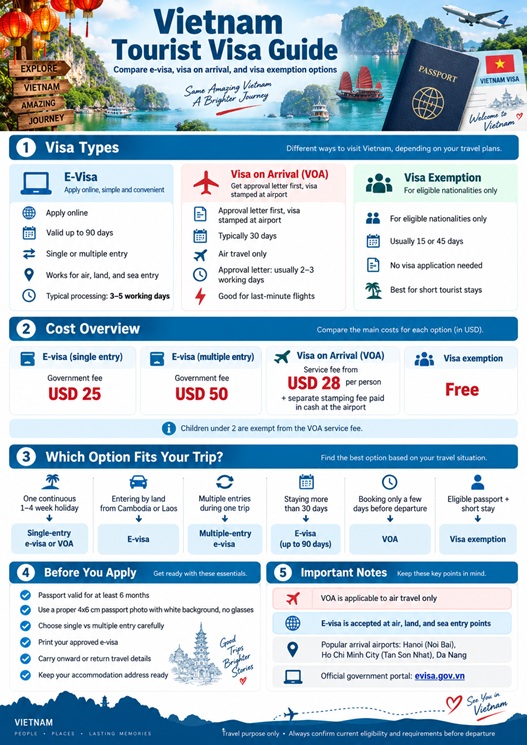
Vietnam tourist visa is the entry document that lets you visit Vietnam for leisure, and it comes in three forms: an e-visa applied for online, a visa on arrival stamped at the airport, or visa-exempt entry if your passport qualifies. Which one fits your trip depends mostly on how you are arriving and how long you plan to stay.
Travelers planning a trip weeks in advance usually prefer the e-visa, since it is issued before departure and removes any uncertainty at the airport counter. Those confirming their Vietnam leg only a few days before flying often lean toward visa on arrival instead, because the approval letter can be issued faster and the final stamp still happens on the day you land.
A smaller group of nationalities do not need either document for short stays, thanks to unilateral visa exemption agreements. If your passport is on that list, the only thing left to plan is how many days you can legally stay before the exemption period runs out.
Below, this guide breaks down each tourist visa type, what each one costs, how long it lasts, and which option matches common trip scenarios, so you can book flights with a clear plan in hand.
Vietnam tourist visa in brief:
| Item | Details |
|---|---|
| Visa types | E-visa, visa on arrival (VOA), visa exemption |
| E-visa validity | Up to 90 days, single or multiple entry |
| VOA validity | Typically 30 days, air travel only |
| Government e-visa fee | USD 25 (single entry) / USD 50 (multiple entry) |
| VOA service fee | From USD 28 per person (children under 2 free) plus a separate stamping fee |
| Processing time | 3-5 working days standard, faster expedited options available |
| Official government portal | evisa.gov.vn |
- What Is a Vietnam Tourist Visa?
- What Types of Vietnam Tourist Visa Can You Choose From?
- How Long Can You Stay in Vietnam on a Tourist Visa?
- How Much Does a Vietnam Tourist Visa Cost?
- Which Tourist Visa Option Is Best for Your Vietnam Trip?
- What Should Tourists Know Before Applying?
- Why Book Your Tourist Visa With a Vietnam Service Provider
- Frequently asked questions
What Is a Vietnam Tourist Visa?
A Vietnam tourist visa is any legal entry document, e-visa, visa on arrival, or visa exemption, that authorizes a foreign traveler to enter Vietnam for tourism rather than business, work or diplomatic purposes. It confirms your identity against your passport bio page, sets a maximum stay, and records whether you may enter once or multiple times during that period.
Unlike a business visa (DN1, DN2) or a work-related permit, a tourist visa does not require a letter of invitation from a Vietnamese company. You still need a guaranteeing agency for visa on arrival specifically, but for tourism purposes this role is filled by a licensed visa service provider on your behalf, not by an employer or business partner.
The distinction matters at immigration. Officers check your stated purpose against your visa type, so applying under the tourist category and later trying to conduct business meetings on the same document can create problems at the port of entry or exit. If your trip mixes leisure and light business activity, apply under whichever purpose is dominant, and consider a separate visa if the business component is substantial.
For most travelers researching Vietnam's tourist visa options for the first time, the practical question is not the legal definition but which of the three paths, e-visa, visa on arrival, or exemption, actually applies to their passport and itinerary. The rest of this guide answers that question section by section, starting with a direct comparison of the three types.
What Types of Vietnam Tourist Visa Can You Choose From?
Three paths lead to legal tourist entry: the e-visa, visa on arrival, and visa-exempt entry. Each suits a different combination of nationality, travel timeline, and entry point.
Vietnam E-Visa for Tourists
The e-visa is an electronic authorization applied for entirely online through the government's evisa.gov.vn portal or through a service provider that submits the application on your behalf. You upload a scan of your passport bio page and a digital photo, pay the fee, and receive the approved e-visa by email, typically within 3-5 working days.
A tourist e-visa is valid for up to 90 days and is available with single or multiple entry. It works at air, land and sea border gates alike, which makes it the more flexible choice if your itinerary includes an overland crossing from Cambodia or Laos partway through the trip.
Note: You must print the approved e-visa and carry the physical copy, since some border gates still check the paper document alongside your passport.
Visa on Arrival (VOA) for Tourists
Visa on arrival works differently. A service provider first submits your details to Vietnam Immigration to obtain an approval letter, which typically takes 2-3 working days for the standard service (faster expedited tiers are available for an added fee). You then travel to Vietnam and get the visa physically stamped into your passport at the airport counter upon arrival, after paying the visa stamping fee in cash.
Visa on arrival is applicable to air travel only. If you plan to enter by land or sea, this option will not work, and you should apply for an e-visa or confirm exemption instead.
The typical VOA stay for tourists is 30 days, though longer durations can be requested depending on nationality and purpose. Because the approval letter can often be processed faster than a full e-visa in genuine time-pressure situations, VOA remains popular with travelers who confirm their Vietnam flight close to departure. For a deeper look at faster processing tiers, see our rush visa processing guide.
Visa-Exempt Entry for Short Tourist Stays
A limited number of nationalities can enter Vietnam for tourism without applying for any visa at all, under unilateral or reciprocal exemption agreements. Exempt stays are shorter than most e-visa or VOA options, generally capped at 15 or 45 days depending on the agreement, and re-entry within a certain window can reset or restrict the exemption period.
Exemption status depends entirely on your nationality, and the list changes periodically as Vietnam signs or renews agreements. Check the full country exemption list and stay limits before assuming you qualify, since applying for a paid visa unnecessarily is avoidable with five minutes of checking.
How Long Can You Stay in Vietnam on a Tourist Visa?
Stay length depends on which visa type you hold and which entry option you selected when applying. Matching this to your actual itinerary before you apply avoids the cost and hassle of extending or renewing mid-trip.
Single-Entry vs Multiple-Entry for Tourism
A single-entry tourist visa lets you enter Vietnam once and stay until your visa's validity period ends; leaving the country, even for a day trip to a neighboring country, voids the remaining validity. Multiple-entry allows you to exit and re-enter Vietnam repeatedly within the approved window.
Single entry works for most straightforward holidays: fly in, tour the country, fly out. Multiple entry suits travelers doing a regional loop, for example Vietnam, then Cambodia's Angkor Wat, then back into Vietnam to finish the trip, or digital nomads splitting a longer Southeast Asia stay across several short visits.
- Choose single entry if your Vietnam leg is one continuous stay with no planned exits.
- Choose multiple entry if your itinerary crosses in and out of Vietnam more than once.
- Multiple-entry e-visas cost more upfront (USD 50 vs USD 25) but avoid the cost and delay of a fresh application if plans change.
30-Day vs 90-Day Tourist Stays
E-visas can be issued for up to 90 days, while visa on arrival for tourism is typically capped at 30 days. If you are planning an extended backpacking trip, a slower-paced retirement stay, or a multi-region tour that genuinely needs more than a month, the 90-day e-visa is usually the better fit, and it avoids the mid-trip extension paperwork a 30-day VOA stay might require.
A shorter 2-3 week holiday rarely needs the longer validity, and either option will comfortably cover it. In that case, the deciding factor becomes speed and entry point rather than duration: VOA if you are flying and confirming late, e-visa if you have more lead time or plan to cross a land border.
How Much Does a Vietnam Tourist Visa Cost?
Tourist visa costs split into two parts: the government fee that goes to Vietnam Immigration, and the service fee charged by whoever submits and manages your application. Budgeting for both prevents surprises.
| Visa type | Government fee | Service fee | Total range |
|---|---|---|---|
| E-visa, single entry | USD 25 | Varies by provider | USD 25 and up |
| E-visa, multiple entry | USD 50 | Varies by provider | USD 50 and up |
| Visa on arrival | Stamping fee paid in cash at the airport (separate from service fee) | From USD 28 per person | From USD 28 plus stamping fee |
| Visa exemption | None | None | Free |
Note: Children under 2 years old are exempt from the VOA service fee. The visa stamping fee for VOA is always paid separately, in cash, directly at the airport counter, and it is non-refundable once the stamp is applied. Government fees are set under Circular No. 28/2026/TT-BTC and apply regardless of which provider you use to submit your application. See the full e-visa fee breakdown for multi-traveler pricing.
Faster processing tiers, same-day or emergency turnaround, cost more than the standard timeline above. If your departure is close and you need the visa confirmed quickly, review the expedited pricing tiers rather than assuming standard processing will meet your deadline.
Which Tourist Visa Option Is Best for Your Vietnam Trip?
The right choice depends on your entry point, timeline and how many times you plan to cross Vietnam's borders during the trip.
| Trip scenario | Best option | Why |
|---|---|---|
| Flying in, one continuous 1-4 week holiday | Visa on arrival or single-entry e-visa | Simple, matches a single stay, no need for the 90-day validity |
| Crossing overland from Cambodia or Laos | E-visa | VOA is applicable to air travel only |
| Regional loop with multiple Vietnam entries | Multiple-entry e-visa | Avoids reapplying each time you re-enter |
| Extended stay over 30 days | E-visa (up to 90 days) | VOA's typical 30-day cap does not cover longer trips |
| Confirming Vietnam flight only days before departure | Visa on arrival, expedited tier | Approval letter can often be processed faster than a full e-visa |
| Eligible nationality, short trip under 45 days | Visa exemption | No visa fee or application needed at all |
If more than one scenario applies, prioritize whichever constraint is hardest to work around, usually entry point (land vs air) or timeline (how many working days remain before departure), and choose accordingly.
What Should Tourists Know Before Applying?
A few practical details catch tourists off guard more often than the visa rules themselves.
Popular Airports and Entry Points for Tourist Arrivals
Most tourist arrivals land at Noi Bai International Airport (Hanoi), Tan Son Nhat International Airport (Ho Chi Minh City), or Da Nang International Airport, all of which process both e-visa and VOA arrivals routinely. Vietnam also maintains 30+ land border gates for overland entry, which accept e-visa holders but not VOA, since visa on arrival is applicable to air travel only.
If your itinerary includes a land crossing at any point, even if you fly in initially, apply for an e-visa rather than VOA so the same document covers every port of entry or exit on your route.
Common Mistakes Tourists Make With Vietnam Visas
Most rejected or delayed applications trace back to a handful of repeat errors:
- Submitting a passport photo that does not meet the 4x6cm, white background, no glasses specification, or one taken more than six months earlier.
- Applying for single entry when the itinerary actually requires re-entering Vietnam.
- Assuming VOA works for a land border crossing, when it does not require a visa on arrival by land, only by air.
- Letting passport validity run under six months remaining at the time of travel.
- Misreading the ICAO lines on the passport data page when entering details manually, which mismatches the application against the passport.
Proof of Onward Travel and Itinerary Tips
Vietnam Immigration does not always ask for a return or onward ticket at the counter, but airlines frequently do before allowing you to board, since they are liable for passengers who cannot legally enter their destination. Carry a booked onward flight or a refundable itinerary, along with your temporary residential address in Vietnam, whether that is a hotel booking or the address of family or friends you are staying with.
Extending a Tourist Visa While in Vietnam
If your trip runs longer than your original visa allows, an extension is possible in many cases, generally handled through the local immigration office or a visa service provider while you are still inside Vietnam. Extensions are easier to arrange for e-visa holders than for a 30-day VOA stay, and starting the process at least a few working days before your current visa expires avoids any gap in legal status.
Note: Overstaying, even briefly, can result in fines or complications when leaving the country. If you are unsure whether your trip will run long, apply for the 90-day e-visa upfront rather than relying on an extension.
Applying as a Family or Group on a Tourist Visa
Traveling with family or a tour group changes how many people you can process on a single application. Visa on arrival applications can cover up to 20 travelers per submission, which suits families and small tour groups landing on the same flight and applying for the same approval letter. E-visa applications are limited to 5 people per submission, since each traveler's details are tied individually to the online government form.
- For groups larger than 5 traveling together by air, visa on arrival is usually simpler to coordinate.
- For groups crossing land borders, each traveler needs an individual e-visa, since VOA does not cover land entry regardless of group size.
- Children traveling on their own passport still need their own visa or exemption status; a child cannot travel on a parent's visa.
Why Book Your Tourist Visa With a Vietnam Service Provider
Applying directly through evisa.gov.vn is always an option, and nothing here should be taken to imply otherwise. What a service provider adds is review of your documents before submission, so a photo spec error or a mismatched passport number gets caught before it delays your approval, plus support if something goes wrong close to your departure date.
Ready to apply? Start your Vietnam visa application with our team, or check our step-by-step application guide for the full process before you begin.
- No Hidden Charges
- Competitive price
- Fast reliable services
- Prompt Support via chat, email, phone
- Customer - Focused approach
- Money-back guarantee for declined applications
Frequently Asked Questions
Do I need a visa to visit Vietnam as a tourist?
Most nationalities do require a visa, either an e-visa or visa on arrival, but a limited number of countries have exemption agreements covering short stays. Check the visa exemption list to confirm your specific nationality.
How long does a Vietnam tourist visa take to process?
Standard e-visa processing takes 3-5 working days, and standard visa on arrival approval letters typically take 2-3 working days. Expedited tiers are available if you need a faster turnaround.
Can I extend my Vietnam tourist visa?
Yes, in many cases. E-visas are generally easier to extend than a 30-day visa on arrival, and starting the extension process before your current visa expires avoids any gap in legal status.
What is the difference between a tourist e-visa and visa on arrival?
An e-visa is approved and issued entirely online before you travel and works at air, land and sea border gates. Visa on arrival requires an approval letter in advance but the final stamp happens at the airport counter, and it is applicable to air travel only.
Can tourists get a multiple-entry visa for Vietnam?
Yes. The e-visa is available with multiple entry for USD 50 (government fee), which suits travelers doing a regional loop that crosses in and out of Vietnam more than once.
What documents do tourists need for a Vietnam visa?
You will need a passport valid for at least six months, a scanned passport bio page, a passport-sized photo (4x6cm, white background, no glasses), and payment for the applicable government and service fees.
Is visa on arrival only for tourists?
No. Visa on arrival is available for both tourism and business purposes, but the underlying purpose must match what you declared on the application, since immigration checks the stated purpose against your visa type at the port of entry.
