
Vietnam Visa Requirements 2026
Full Vietnam visa requirements checklist: passport rules, photos, documents, and fees for e-visa, visa on arrival, and embassy visa. Apply with us today.

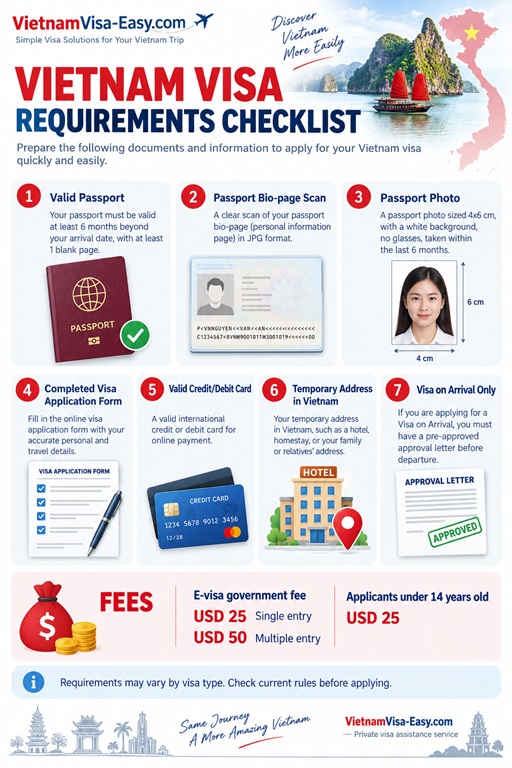
Vietnam visa requirements come down to four core items: a passport valid for at least six months beyond your arrival date, one 4x6cm photo, a completed application, and the correct fee for whichever visa type you choose. Every eligible traveler needs all four, but the exact document set and where you submit it change depending on whether you apply for an e-visa, a visa on arrival, or a visa at a Vietnamese embassy or consulate.
The document checklist is nearly identical across visa types. What differs is the submission method: the e-visa is filed online for entry by air, land, or sea, visa on arrival requires a pre-approved approval letter picked up at the airport counter, and an embassy visa is filed in person or by mail well before departure. Below, each requirement is broken down so you know exactly what to prepare before you start.
Passport condition and photo specification cause most of the avoidable rejections applicants run into. A passport with fewer than six months of remaining validity, a torn bio page, or a photo with a colored background or glasses will all stall an otherwise straightforward application. The requirements below cover each of these in detail, with the exact specification for every document type.
Below, the checklist starts with the documents every applicant needs, then narrows into passport rules, photo rules, and the differences between visa types, before covering fees and exemption status.
Vietnam visa requirements in brief:
| Item | Requirement |
|---|---|
| Passport validity | At least 6 months beyond arrival date, with at least 1 blank page |
| Photo | 4x6cm, white background, no glasses, taken within the last 6 months |
| Application | Online form (e-visa) or printed form (visa on arrival, embassy visa) |
| Government fee | USD 25 (single entry) / USD 50 (multiple entry), under 14 flat USD 25 |
| Service fee (VOA) | From USD 28/person, free under age 2, plus a cash stamping fee at the airport |
| Entry points | 190+ e-visa eligible countries, 30+ land border gates |
| Legal basis | Circular No. 28/2026/TT-BTC |
- What Are the Requirements to Get a Vietnam Visa?
- What Documents Do You Need for a Vietnam Visa?
- What Are the Passport Requirements for a Vietnam Visa?
- What Are the Photo Requirements for a Vietnam Visa?
- How Much Does a Vietnam Visa Cost?
- Who Is Exempt From Vietnam Visa Requirements?
- What Other Vietnam Visa Requirements Should You Know?
- Frequently asked questions
What Are the Requirements to Get a Vietnam Visa?
Every applicant, regardless of nationality or visa type, needs four things in place before submitting: a valid passport, a compliant photo, a completed application form, and payment for the applicable fee. These four items form the Vietnam visa requirements baseline, and the sections below expand on each one.
A fifth item applies to visa on arrival specifically: a pre-approved approval letter issued before departure, which you present at the airport counter along with your passport and photo to get the visa stamped. Without this letter, visa on arrival is not available. The e-visa skips this step entirely, since approval and the visa itself both arrive as a single electronic document.
You will also need a temporary address in Vietnam, generally a hotel booking, homestay, or the address of family or relatives, since the application form asks for this on every visa type. This address does not need to be finalized months in advance. A confirmed hotel reservation from any major booking platform satisfies the requirement.
For e-visa and visa on arrival, applicants also need a valid international credit or debit card to pay the government and service fees online. Embassy and consulate applications sometimes accept cash payment in person instead, depending on the specific mission, so check with your nearest embassy if you are applying that way.
The purpose of your trip also shapes which application form field you complete, though it rarely changes the underlying document list. Tourism and short family visits use the standard visa category on the form, while business travel adds a field for the guaranteeing agency or organization sponsoring your entry. If you are traveling for business without a Vietnam-based sponsor, an e-visa or visa on arrival under the tourism category still covers most short business trips; a sponsored business visa (DN1 or DN2) is only needed for longer work assignments.
What Documents Do You Need for a Vietnam Visa?
The core document set is short, and the same items apply whether you are applying for tourism, business, or a short family visit. Prepare these before you start any application:
- A passport with at least 6 months of validity remaining beyond your planned arrival date.
- A clear, scanned copy in .jpg format of your passport's bio (data) page.
- A passport-sized photo in .jpg format (4x6cm, white background, no glasses).
- A valid international credit or debit card for online fee payment.
- A temporary address in Vietnam (hotel, homestay, or the address of family or relatives).
- For visa on arrival only: your pre-approved approval letter, printed or on your phone.
- For embassy applications: a printed application form and, in some cases, a return envelope.
Note: some embassies request an additional passport photo printed on paper, even when the online form also asks for a digital copy. Check the requirements page of your nearest Vietnamese embassy or consulate before you travel there in person.
Do Vietnam Visa Requirements Differ Between E-Visa, Visa on Arrival, and Embassy Visa?
Yes. While the underlying documents overlap heavily, the submission process and one or two extra items differ by visa type.
| Requirement | E-visa | Visa on arrival | Embassy visa |
|---|---|---|---|
| Passport scan | Uploaded online | Uploaded when requesting the approval letter | Submitted in person or by mail |
| Photo | Uploaded online | Presented at the airport counter | Submitted with the paper form |
| Approval letter | Not required | Required before departure | Not applicable |
| Entry points | Air, land, sea, 30+ land gates | Air travel only | Depends on the issuing mission |
| Payment method | Card, online | Card online for the letter, cash for the stamping fee | Cash or card, by mission |
| Processing location | Online, no embassy visit | Airport counter on arrival | Embassy or consulate, in advance |
E-visa applicants skip the approval letter step and the airport counter entirely, since the visa itself is emailed once approved after submission through the official e-visa portal or an assisted service that reviews your documents first. Visa on arrival applicants still need the online step first, to get the approval letter, and only complete the process physically at the airport. Embassy applications are the only route that requires an in-person visit or postal submission before departure, which is also why embassy processing generally takes longer than either online option.
Embassy and consulate applications also vary in required extras from one mission to another. Some ask for a flight itinerary or hotel booking printed and attached to the form; others accept a digital copy shown on your phone. Since these extra requirements are set by each individual mission rather than by a single national standard, confirm the exact list with your nearest Vietnamese embassy or consulate before your appointment, especially if you are applying by mail rather than in person.
What Are the Passport Requirements for a Vietnam Visa?
Your passport must be valid for at least 6 months beyond your intended arrival date in Vietnam. A passport expiring sooner will be rejected at the application stage or, worse, at the airport counter itself. Renew before applying if your passport is close to that threshold.
The passport also needs at least one blank page for the visa stamp, separate from the ICAO lines and machine-readable zone on the bio page. If your passport is nearly full, request additional pages or a new passport before starting your Vietnam visa application.
Your passport bio page scan must be legible: all four corners visible, no glare washing out the printed text, and the photo page itself unobstructed by a cover or sleeve. A blurry or cropped bio page scan is one of the most common reasons an e-visa submission gets sent back for resubmission.
If your passport was recently renewed and your name, date of birth, or passport number changed from a previous visa or booking, make sure every document you submit, including flight bookings and hotel reservations, matches the new passport exactly. Mismatches between documents are treated as a data error, not a minor typo, and can delay processing.
What Are the Photo Requirements for a Vietnam Visa?
The photo requirement is identical across all three visa types: 4x6cm, white background, no glasses, taken within the last 6 months. This applies whether you are submitting a digital copy for an e-visa, a printed photo for an embassy application, or a photo alongside your approval letter for visa on arrival.
Common rejection causes for photos include a colored or patterned background, glasses (even clear prescription lenses), shadows across the face from uneven lighting, and photos older than 6 months where your appearance has visibly changed. A plain white background photographed under even lighting, with a neutral expression and both ears visible, satisfies the requirement for every visa type.
Digital copies should be saved in .jpg format, under the file-size limit stated on the application portal you are using. If you are applying through a printed embassy form, bring a physical, freshly printed photo rather than a home-printed copy on regular paper, since some missions specifically require photo-paper prints.
How Much Does a Vietnam Visa Cost?
Vietnam visa costs split into two parts: the government fee, which is the same regardless of who processes your application, and a service fee if you use an assisted service such as vietnamvisa-easy.com instead of applying directly.
- E-visa government fee: USD 25 for a single entry, USD 50 for multiple entries. Applicants under 14 pay a flat USD 25 regardless of entry type.
- Visa on arrival service fee: from USD 28 per person, free for children under age 2, plus a separate stamping fee paid in cash at the airport counter upon arrival.
- Embassy visa fee: varies by mission and entry type, generally payable in cash or by card depending on the specific embassy or consulate.
Note: the stamping fee for visa on arrival is non-refundable and must be paid in cash, either USD or VND, directly at the airport counter. It is not included in the online service fee, and no airport counter in Vietnam accepts a card for this specific payment.
Under Circular No. 28/2026/TT-BTC, the government e-visa fee schedule above is the current, published rate. vietnamvisa-easy.com is a private agency, not a government office, and any service fee charged on top of the government fee covers document review, form submission, and support, not the visa itself.
Faster processing tiers exist for travelers on a tight schedule, ranging from standard 5-7 working day service up to a super urgent tier processed in as little as 1.5 working hours, including weekends and holidays. These tiers change only the total fee and processing time, not the underlying document requirements described above; the same passport, photo, form, and fee still apply, just reviewed and submitted faster. For the full fee table broken down by processing tier, see the visa fee guide.
Who Is Exempt From Vietnam Visa Requirements?
A limited number of nationalities are exempt from Vietnam visa requirements entirely, generally for short stays of 14 to 45 days depending on the country and any bilateral agreement in place. If your nationality is on this list, you can enter Vietnam without applying for any visa at all, though your passport still needs to meet the 6-month validity rule.
Exemption status depends entirely on nationality and does not extend automatically to a spouse or child holding a different passport. Each traveler's passport is checked individually at the border, regardless of who else is in the group. For the full country-by-country exemption list and stay-length limits, see the visa exemption guide.
A separate, narrower exemption applies to travelers flying directly to Phu Quoc Island and staying only there: a 30-day stay is permitted without a visa, regardless of nationality, as long as the traveler does not leave the island for the mainland.
What Other Vietnam Visa Requirements Should You Know?
Beyond the core document checklist, a handful of situations come with their own requirement wrinkles: children traveling on a parent's itinerary, multiple-entry visas, and the specific reasons applications get rejected. The sections below cover each.
What Are the Requirements for Children and Minors?
Every child, regardless of age, needs their own passport and their own visa or visa exemption; a child cannot travel to Vietnam on a parent's passport. Infants under age 2 are exempt from the visa on arrival service fee, but the passport, photo, and application requirements still apply in full.
For children too young to sign an application form, a parent or legal guardian completes and signs the form on the child's behalf. The photo requirement, 4x6cm, white background, no glasses, applies to infant and toddler photos exactly as it does to adults, which can take a few attempts to capture cleanly.
If a child's passport was recently issued, their name and date of birth must match exactly across the passport, the application form, and any flight booking submitted alongside the family's applications. Since a newborn or toddler's passport photo can look noticeably different within a matter of months, plan to take the required photo close to the actual application date rather than reusing an older photo from a previous trip.
What Are the Requirements for a Multiple-Entry Visa?
A multiple-entry visa follows the same document checklist as a single-entry visa, with two differences: the government fee is higher, USD 50 instead of USD 25 for the e-visa, and you should specify multiple entry clearly on the application form itself, since it cannot be upgraded after issuance.
If your travel plans include a side trip to Cambodia, Laos, or another neighboring country with a return to Vietnam, apply for multiple entry from the start. Re-entering Vietnam on a single-entry visa that has already been used is not possible, and applying for a second visa mid-trip adds delay and cost you can avoid by planning ahead.
What Are Common Reasons a Vietnam Visa Application Gets Rejected?
Most rejections trace back to a small set of repeat issues rather than eligibility problems. The most frequent causes are:
- Passport validity under 6 months remaining at the time of arrival.
- A blurry, cropped, or glare-affected bio page scan.
- A photo with a non-white background, glasses, or taken more than 6 months earlier.
- Name, date of birth, or passport number mismatches between the application and the passport.
- An expired approval letter presented at the airport counter for visa on arrival.
Note: an expired approval letter cannot be extended at the counter. If your travel dates shifted after the letter was issued, request a new one before you fly, not after you land.
Do Requirements Differ at Land Border Gates Versus Airports?
The e-visa is accepted at all 30+ designated land border gates as well as international airports and seaports, using the same document set described above. Visa on arrival, by contrast, is valid for air travel only and cannot be used at a land border gate under any circumstance.
If your itinerary includes crossing into Vietnam overland, from Cambodia, Laos, or China, apply for either the e-visa or an embassy visa in advance. Arriving at a land gate without a valid e-visa, embassy visa, or exemption status will result in denied entry, since visa on arrival is not an option at any land crossing.
- No Hidden Charges
- Competitive price
- Fast reliable services
- Prompt Support via chat, email, phone
- Customer - Focused approach
- Money-back guarantee for declined applications
Frequently Asked Questions
Do I need a visa to visit Vietnam?
Most nationalities do need a visa to visit Vietnam. A limited number of countries are exempt for short stays, generally 14 to 45 days depending on the agreement in place; check the visa exemption guide to confirm your nationality's status.
How long must my passport be valid for a Vietnam visa?
Your passport must be valid for at least 6 months beyond your planned arrival date, with at least one blank page for the visa stamp.
What are the photo requirements for a Vietnam visa?
Vietnam visa photos must be 4x6cm, white background, no glasses, and taken within the last 6 months, regardless of which visa type you apply for.
Can a child get a Vietnam visa without a personal passport?
No. Every child needs their own passport and their own visa or exemption status; children cannot travel to Vietnam on a parent's passport.
What happens if my Vietnam visa application is rejected?
You can correct the issue, usually a passport scan, photo, or data mismatch, and resubmit. For visa on arrival, an expired approval letter requires requesting a new one before departure, since it cannot be extended at the airport counter.
Do visa on arrival and e-visa have the same requirements?
The core documents overlap heavily: passport, photo, application, and fee. Visa on arrival additionally requires a pre-approved approval letter obtained before departure and is valid for air travel only, while the e-visa needs no letter and covers air, land, and sea entry.
