
Vietnam Visa Blog
This Vietnam visa blog compares e-visa, VOA and embassy visa options, breaks down fees and documents, and shows you how to apply with our team.

This Vietnam visa blog brings together everything a first-time traveler needs before entering Vietnam: the e-visa, visa on arrival, embassy visa, current fees, required documents, and the fastest way to apply. You get the practical version in one place, not pieced together from several government pages.
Most travelers researching Vietnam visas run into three separate systems, the e-visa portal, the airport visa on arrival process, and the traditional embassy application, each with its own cost and processing time. Knowing which one matches your itinerary before you start saves you from paying twice or missing a deadline.
Fees also vary by entry type and how fast you need the visa confirmed, and the government charges a separate amount from any service provider fee. This guide breaks both down clearly, along with the documents you need before you submit anything.
Below, this Vietnam visa blog walks through what each visa type covers, what documents and fees to expect, and how to apply step by step.
Vietnam visa blog in brief:
| Item | Details |
|---|---|
| Visa types covered | E-visa, visa on arrival (VOA), embassy visa |
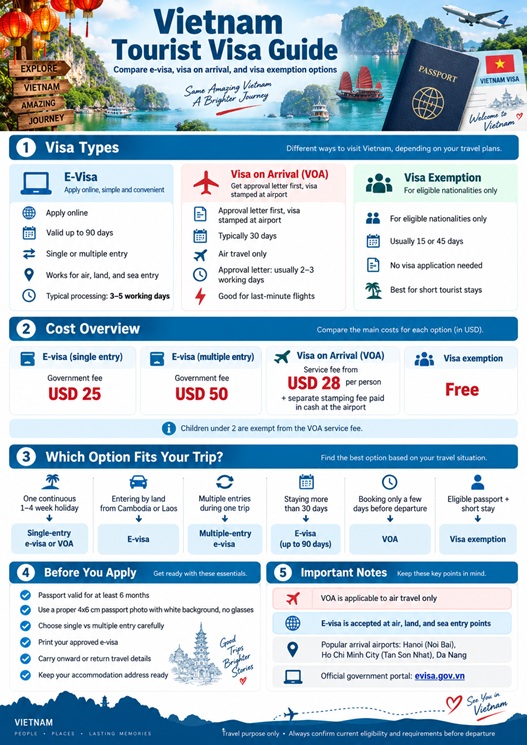
| Government e-visa fee | USD 25 (single entry) / USD 50 (multiple entry) |
| VOA service fee | From USD 28 per person, plus a separate stamping fee paid in cash |
| Standard processing | 3-5 working days |
| Fastest emergency option | From 1.5 working hours |
| Eligible countries for e-visa | 190+ |
| Official government portal | evisa.gov.vn |
What Does This Vietnam Visa Blog Cover?
This Vietnam visa blog focuses on the three legal ways to enter Vietnam, e-visa, visa on arrival, and a visa issued directly by an embassy or consulate, along with the fees, documents, and processing times attached to each. It is written for travelers who have not applied before and want the full picture before picking a method.
If you already know your nationality and just need country-specific detail, the Vietnam visa requirements by nationality page goes deeper on individual passport rules. This guide stays at the practical, apply-this-week level, and every fee below is what an applicant actually pays, not legal text.
What Types of Vietnam Visa Can You Apply For?
Three paths lead to legal entry into Vietnam: the e-visa, visa on arrival, and a visa issued directly by a Vietnamese embassy or consulate. Each suits a different combination of nationality, entry point, and how far ahead you are planning.
Vietnam E-Visa
The e-visa is an electronic authorization applied for entirely online, either directly on evisa.gov.vn or through a service provider. You upload your passport bio page and a photo, pay the government fee, and receive the approved e-visa by email, typically within 3-5 working days.
A Vietnam e-visa is valid for up to 90 days with single or multiple entry, and it works at air, land, and sea border gates, which suits an overland crossing from Cambodia or Laos.
Visa on Arrival (VOA)
Visa on arrival works differently. A service provider first obtains an approval letter from Vietnam Immigration, then you travel to Vietnam and get the visa stamped into your passport at the airport counter, paying the stamping fee in cash on the spot.
Visa on arrival is applicable to air travel only. For a deeper walkthrough of this process, see our visa on arrival guide.
Vietnam Embassy or Consulate Visa
An embassy visa is a sticker placed directly in your passport, arranged in person or by mail at a Vietnamese embassy or consulate abroad. It generally takes longer than an e-visa or VOA, so it mainly fits travelers whose passport situation rules out the faster two options.
What Documents Do You Need for a Vietnam Visa?
Requirements are largely the same across e-visa and VOA applications, with only minor differences in how each document is submitted.
- A passport valid for at least six months from your arrival date.
- A clear scan of your passport bio page in .jpg format.
- A passport-sized photo (4x6cm, white background, no glasses) taken within the last 6 months.
- A valid credit or debit card for the government e-visa fee, if applying online.
- A temporary residential address in Vietnam, such as a hotel booking, to list on the application.
Note: An embassy visa application also asks for your original passport, since the sticker is applied to the physical document rather than issued digitally.
How Much Does a Vietnam Visa Cost?
Vietnam visa costs split into two parts: the government fee, and the service fee charged by whoever submits your application. Budgeting for both avoids surprises later.
| Visa type | Government fee | Service fee | Total range |
|---|---|---|---|
| E-visa, single entry | USD 25 | Varies by provider | USD 25 and up |
| E-visa, multiple entry | USD 50 | Varies by provider | USD 50 and up |
| Visa on arrival | Stamping fee, paid in cash at the airport | From USD 28 per person | From USD 28 plus stamping fee |
| Embassy visa | Varies by embassy | Usually not required | Varies |
Government fees are set under Circular No. 28/2026/TT-BTC regardless of provider. See the full Vietnam visa fee breakdown for multi-traveler pricing.
How Do You Apply for a Vietnam Visa Step by Step?
The process is short once you know which visa type fits your trip.
- Choose the visa type that matches your entry point (air, land, or sea) and your departure date.
- Submit your passport scan, photo, and travel details online, or hand them to your service provider.
- Receive your approved e-visa by email or your VOA approval letter within the confirmed processing time.
- Print the e-visa, or carry the printed approval letter for VOA, and travel to Vietnam.
- Present your documents at the port of entry and, for VOA, pay the stamping fee in cash.
Note: If your departure is close, faster processing tiers exist for both e-visa and VOA, usually for an added fee.
What Else Should You Know Before You Apply?
A few details beyond the basic process catch first-time applicants off guard.
Which Nationalities Are Exempt From a Vietnam Visa?
Some nationalities do not need a visa for short stays, under unilateral exemption agreements generally capped at 15 or 45 days. The full exemption list confirms whether your passport qualifies.
How Fast Can You Get an Urgent Vietnam Visa?
If your departure is close, emergency processing can confirm a visa in as little as 1.5 working hours, including weekends and holidays, for an added fee. Our urgent visa service guide covers every expedited tier.
What Common Mistakes Do Travelers Make on Vietnam Visa Applications?
Most rejected or delayed applications trace back to a handful of repeat errors:
- Submitting a photo that does not meet the 4x6cm, white background, no glasses specification.
- Applying for visa on arrival when the itinerary actually includes a land border crossing.
- Letting passport validity run under six months remaining at the time of travel.
Why Apply Through a Vietnam Visa Service Provider?
Applying directly on evisa.gov.vn is always an option. What a service provider adds is review of your documents before submission, so a photo spec error or a mismatched passport number gets caught before it delays your approval.
vietnamvisa-easy.com has operated through parent company Discover Asia Travel since 2003, and it is a private agency, not a government office or embassy. The team has processed over 6,639 visas for more than 5,200 satisfied customers, with a 99.9% success rate, upfront fees, and a money-back guarantee if a visa is not delivered on time.
Ready to apply? Start your Vietnam visa application with our team, or use our step-by-step apply form directly.
Read more about Vietnam Visa Blog
- 7 Best Vietnam Islands Without Permission to Visit in 2026
- Vietnam Visa on Arrival: 9 Things You Need to Know Before You Fly
- Off the Beaten Track in Pu Luong: 7 Hidden Trails for 2026
- Kite Surfing in Mui Ne: Complete 2026 Guide to Best Spots
- Ha Giang 4 Days 3 Nights by Motorbike: Best Guide
- Gia Lai Travel Guide: Highlights and Best Tips 2026
- Vietnam Pre-Arrival Form: Complete 2026 Guide for Travelers
- Vietnam Visa Photo Size and Requirements
- No Hidden Charges
- Competitive price
- Fast reliable services
- Prompt Support via chat, email, phone
- Customer - Focused approach
- Money-back guarantee for declined applications
Frequently Asked Questions
What is the difference between a Vietnam e-visa and visa on arrival?
An e-visa is approved and issued entirely online before you travel and works at air, land, and sea border gates. Visa on arrival requires an approval letter in advance, but the final stamp happens at the airport counter, and it is applicable to air travel only.
How long does it take to get a Vietnam visa?
Standard e-visa processing takes 3-5 working days, and standard visa on arrival approval letters typically take 2-3 working days. Emergency tiers can confirm a visa in as little as 1.5 working hours.
Is visa on arrival available for land border crossings?
No. Visa on arrival is applicable to air travel only. If your itinerary includes a land or sea crossing, apply for an e-visa instead.
Do I need to scan my passport to apply for a Vietnam visa?
Yes, for both the e-visa and visa on arrival you submit a clear scan of your passport bio page. An embassy visa instead requires your original physical passport.
Can I get an emergency Vietnam visa within 24 hours?
Yes. Expedited and same-day tiers exist for both e-visa and visa on arrival, with the fastest emergency option confirming a visa in as little as 1.5 working hours for an added fee.
