
Vietnam Pre-Arrival Form: Complete 2026 Guide for Travelers
Fill out the Vietnam pre-arrival form correctly before you fly. Step-by-step guide to the 2026 declaration, deadlines, and how it affects your visa.

The Vietnam pre-arrival form is a free online declaration that non-Vietnamese passport holders must submit before landing at Tan Son Nhat International Airport in Ho Chi Minh City. You complete it at prearrival.immigration.gov.vn, and the system emails you a QR code that immigration officers scan at the arrival hall. It does not replace your visa, your e-visa, or your visa on arrival approval letter, it is an additional step that runs alongside whichever entry document you already hold.
If you are wondering whether this form applies to your trip, the short answer depends on your arrival airport. As of September 2026, only Tan Son Nhat (SGN) enforces the requirement. Noi Bai International Airport in Hanoi and Da Nang International Airport have not adopted it yet, though travel advisories suggest wider rollout is likely.
Many travelers also confuse the digital pre-arrival form with Form NA1, the older paper arrival card still used for visa on arrival processing at airport counters and at land border crossings. The two documents serve different purposes and, depending on your entry method, you may need to complete both rather than choosing one over the other. Below, you will find the difference explained clearly, along with the exact fields the online form asks for and the submission window you need to respect.
The rest of this guide walks through who must file the declaration, the step-by-step process, and how it fits alongside your Vietnam e-visa or visa on arrival application. If you still need to arrange the visa itself, this application guide covers that separately.
Vietnam pre-arrival form in brief:
| Item | Detail |
|---|---|
| Official website | prearrival.immigration.gov.vn |
| Fee | Free of charge |
| Submission window | 24-72 hours before arrival |
| Time to complete | 3-5 minutes with documents ready |
| Airports enforcing it | Tan Son Nhat (SGN) only, as of September 2026 |
| Replaces your visa? | No, it is filed in addition to your e-visa or visa on arrival |
| Confirmation | QR code, scanned at the arrival hall |
- What Is the Vietnam Pre-Arrival Form?
- Who Needs to Complete the Vietnam Pre-Arrival Form?
- How to Fill Out the Vietnam Pre-Arrival Form
- Troubleshooting Common Problems With the Declaration
- When Should You Submit the Vietnam Pre-Arrival Form?
- Does This Declaration Replace Your Visa?
- Pre-Arrival Form vs. Other Vietnam Entry Documents
- Frequently asked questions
What Is the Vietnam Pre-Arrival Form?
The Vietnam pre-arrival form is an online declaration introduced by Vietnam's Immigration Department that collects your passport details, flight information, and accommodation address before you fly. The requirement took effect on 15 April 2026, initially at Tan Son Nhat International Airport, following a notice issued through the U.S. Embassy and other diplomatic channels to alert travelers of the change.
You submit the declaration through the official government portal, not through an airline, a travel agency, or a third-party booking site. Once your information is validated, the system generates a file number and a downloadable confirmation containing a QR code. Immigration staff scan that code when you reach the arrival hall, which is intended to speed up the physical passport check.
The form exists separately from your visa application. A traveler holding a valid Vietnam e-visa, a visa exemption, or a temporary residence card still needs to file the pre-arrival declaration if arriving through SGN. Think of it as a data pre-check, not an entry permit.
Why Vietnam Introduced the Requirement
Immigration authorities designed the declaration to process passenger data electronically ahead of arrival, reducing manual data entry at the counter. Airports handling high volumes of international arrivals, and Tan Son Nhat is Vietnam's busiest, benefit the most from advance passenger screening. Expect other major airports to adopt the same system as the rollout continues, though no confirmed date has been announced for Noi Bai or Da Nang as of this writing.
Vietnam is not alone in moving toward pre-arrival screening. Singapore has run its SG Arrival Card for years, and Thailand introduced its own digital arrival card in 2024. Regional immigration systems are converging on the same model: collect passenger and accommodation data online before departure, then verify it with a single scan on arrival. Travelers who have already filed a similar form for Singapore or Thailand will find the Vietnam version follows a familiar pattern.
Who Needs to Complete the Vietnam Pre-Arrival Form?
Any traveler who does not hold a Vietnamese passport and is arriving at Tan Son Nhat International Airport must complete the pre-arrival declaration. This applies regardless of your entry document, whether you hold an e-visa, a visa on arrival approval letter, a visa exemption certificate, or a temporary residence card.
- Tourists and business travelers flying into Ho Chi Minh City on an international flight.
- Holders of a Vietnam e-visa arriving specifically at Tan Son Nhat.
- Holders of a visa on arrival approval letter landing at Tan Son Nhat (you still complete Form NA1 at the counter separately, see below).
- Citizens of visa-exempt countries who are still required to file the declaration despite not needing a visa.
If your flight lands at Noi Bai (Hanoi) or Da Nang, you are not currently required to file this particular declaration. However, requirements can change with short notice, so check the official portal close to your travel date if your itinerary might shift between airports.
Note: Vietnamese passport holders and travelers arriving overland or by sea are outside the scope of this specific online form.
How to Fill Out the Vietnam Pre-Arrival Form
Most travelers finish the declaration in three to five minutes once they have their passport, visa or entry document, flight itinerary, and hotel address on hand. Gather the following before you start:
- Your passport, open to the bio data page.
- Your e-visa, visa on arrival approval letter, or visa exemption confirmation.
- Your flight number and confirmed arrival date.
- The name and full address of your first hotel or accommodation in Vietnam.
- An email address and phone number you can access before boarding.
Follow these steps in order.
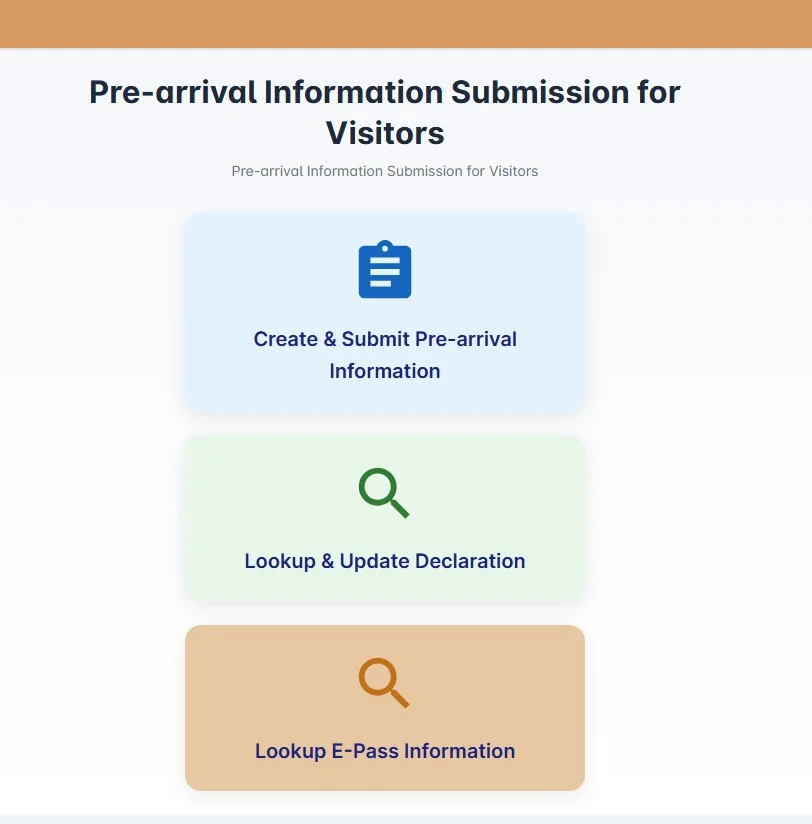
- Go to prearrival.immigration.gov.vn, select your preferred language, and click "Create and Submit Declaration."
- Enter the CAPTCHA code shown on screen to continue.
- Fill in your full name exactly as printed in your passport, passport number, nationality, date of birth, and gender.
- Select your visa type from the dropdown (e-visa, visa exemption, or temporary residence card) and enter the visa number, issue date, and expiry date.
- Add your flight number, expected arrival date, and intended point of entry.
- Enter your first accommodation address in Vietnam, plus a working email address and phone number.
- Review the summary screen carefully, request the six-digit OTP code sent to your email, and enter it to confirm submission.
Note: Triple-check your passport number before submitting. It is the single most common data-entry error travelers report, and it is easier to correct on the review screen than after the declaration is confirmed.
Once verified, the portal assigns a file number and produces a downloadable QR code. Save it to your phone or print it, since the immigration counter at Tan Son Nhat scans this code on arrival.
Traveling With Family
If you are traveling with family members on connected bookings, you can add each person's information within the same declaration session rather than filing separate forms one by one. This keeps the file number linked for the whole group and speeds up the counter check for everyone traveling together.
Troubleshooting Common Problems With the Declaration
Even a short online form runs into snags. Here is how to handle the most common ones without losing your place in the process.
- No OTP email arrives. Check your spam folder first, then request a new code rather than refreshing the page repeatedly, which can invalidate the pending session.
- You notice a typo after submitting. File a new declaration with corrected details using the same passport number, and keep both confirmations on hand in case the counter asks about the mismatch.
- Your flight number changes. Airlines occasionally reassign flight numbers on codeshare routes. Update your declaration once your final flight number is confirmed, ideally within the 24-72 hour window.
- The portal will not accept your submission. Confirm you are inside the 24-72 hour window. Submissions outside that range are rejected automatically, not flagged with a clear error message.
- You cannot find your confirmation before boarding. Check the email address you entered for typos. If the confirmation truly did not arrive, you can file the declaration again rather than boarding without one.
When Should You Submit the Vietnam Pre-Arrival Form?
The portal only accepts submissions within a 24-72 hour window before your scheduled arrival. Submitting too early will not work, since the system is built around near-term flight verification, and waiting until the last few hours before boarding leaves little room to fix a typo if one slips through.
A practical target is to complete the form the evening before departure, once your flight and accommodation details are finalized and unlikely to change. If your flight is delayed or your first night's accommodation changes after submission, you can normally file an updated declaration using the same passport number, though you should still carry your original confirmation as a backup.
Does This Declaration Replace Your Visa?
No, filing the pre-arrival declaration does not replace, waive, or substitute for a Vietnam visa. If your nationality requires an e-visa or a visa on arrival, you must still obtain it through the normal process before you fly. The pre-arrival form is a separate data submission that runs in parallel with your visa, not instead of it.
This distinction trips up a fair number of travelers who assume the QR code alone is sufficient for entry. It is not. Immigration officers at Tan Son Nhat check both your visa or approval letter and your pre-arrival QR code during processing. Missing either document can delay you at the counter, and depending on your visa status, missing your actual visa or approval letter can prevent entry altogether.
If you are applying for the e-visa yourself, the government fee is USD 25 for a single-entry e-visa or USD 50 for a multiple-entry e-visa, payable directly on the official e-visa portal. If you would rather have the whole application checked and submitted for you, including document review before you fly, apply through vietnamvisa-easy.com. The team has processed e-visa and visa on arrival applications since 2003 through its parent company, Discover Asia Travel, with a 99.9% success rate across more than 6,639 visas issued to date.
Pre-Arrival Form Fee vs. Visa Fees: Do Not Confuse Them
The pre-arrival declaration itself is free, but travelers sometimes assume that means their whole entry to Vietnam is free. It is not. Your visa or approval letter carries its own separate fee, paid through a different channel entirely.
| Item | Fee | Paid where |
|---|---|---|
| Pre-arrival declaration | Free | Online at prearrival.immigration.gov.vn |
| E-visa, single entry | USD 25 (government fee) | Online, at application |
| E-visa, multiple entry | USD 50 (government fee) | Online, at application |
| Visa on arrival service fee | From USD 28 per person | Online, when booking the approval letter |
| Visa on arrival stamping fee | Paid in cash | At the airport counter, upon arrival |
Note: Government fees, service fees, and the visa stamping fee are three distinct charges. Confusing one for another is a common reason travelers arrive at the counter without the cash needed for stamping.
Pre-Arrival Form vs. Other Vietnam Entry Documents
Vietnam currently runs two different arrival documents side by side, and knowing which one applies to your situation avoids confusion at the airport.
Digital Arrival Card vs. NA1 Form: What's the Difference?
The digital pre-arrival declaration described in this guide is entirely online and generates a QR code. Form NA1, by contrast, is Vietnam's long-standing paper immigration form, used specifically for travelers collecting a visa on arrival approval letter at the airport counter, and at land and sea border crossings. If you are entering on a visa on arrival, you will likely still complete Form NA1 at the counter in addition to the digital declaration if you land at Tan Son Nhat.
| Document | Format | Who uses it | Where |
|---|---|---|---|
| Pre-arrival declaration | Online, QR code | All non-Vietnamese arrivals at SGN | Tan Son Nhat only |
| Form NA1 | Paper, passport stamp | Visa on arrival holders | Airports, land, and sea border gates |
Form NA1 replaced the older M3 form some years ago and still functions as a combined entry and exit declaration, stamped directly by the immigration officer processing your approval letter. If you fly into Tan Son Nhat on a visa on arrival, expect to complete both documents: the digital declaration before you fly, and Form NA1 at the counter itself.
Common Mistakes That Delay Your Declaration
- Entering a passport number that does not match the passport bio page exactly, including letters and leading zeros.
- Selecting the wrong visa type from the dropdown, which mismatches your actual entry document.
- Submitting outside the 24-72 hour window, which the system rejects.
- Using an email address you cannot access before boarding, since the OTP code and confirmation both arrive there.
- Leaving the accommodation address blank or entering an address outside Vietnam.
What Airports and Border Crossings Are Covered So Far?
As of September 2026, Tan Son Nhat International Airport in Ho Chi Minh City is the only point of entry enforcing the pre-arrival declaration. Noi Bai International Airport in Hanoi, Da Nang International Airport, and Vietnam's land and sea border gates do not require this specific online form yet. Travelers connecting through Ho Chi Minh City before continuing domestically should still file the declaration for the SGN leg of their journey.
If You Also Need a Visa on Arrival
Visa on arrival travelers follow a slightly longer sequence than e-visa holders. You still need an approval letter issued in advance, which you can arrange through our visa on arrival service, and you still pay a visa stamping fee in cash directly at the airport counter, separate from the online declaration described here. The pre-arrival form does not remove any of those existing steps, it simply adds one more data submission before you board.
Read more about Vietnam Visa Blog
- No Hidden Charges
- Competitive price
- Fast reliable services
- Prompt Support via chat, email, phone
- Customer - Focused approach
- Money-back guarantee for declined applications
Frequently Asked Questions
Is the Vietnam pre-arrival form free?
Yes, the official declaration at prearrival.immigration.gov.vn is completely free of charge. You never need to pay to submit it, and any site charging a fee for this specific step is not the official government portal.
Do I need the pre-arrival form if I already have an e-visa?
Yes, if you are landing at Tan Son Nhat. Holding a valid e-visa does not exempt you from the digital pre-arrival declaration, the two are separate requirements that both apply to your trip.
What happens if I don't complete the pre-arrival declaration?
You may face delays at the immigration counter since officers currently scan the QR code as part of standard processing at Tan Son Nhat. To avoid uncertainty, file the declaration within the 24-72 hour window before you fly.
Can I complete the form on arrival at the airport?
The declaration is designed to be submitted before you fly, within 24-72 hours of arrival, since it needs to be validated and matched with your flight in advance. Filing it only after landing defeats its purpose and is not the intended process.
Is the pre-arrival form required for Hanoi or Da Nang airports?
Not currently. As of September 2026, only Tan Son Nhat International Airport in Ho Chi Minh City enforces this requirement. Check the official portal close to your travel date in case coverage expands to other airports.
Does the pre-arrival form work for visa on arrival travelers too?
Yes, visa on arrival travelers landing at Tan Son Nhat still file the pre-arrival declaration, in addition to completing Form NA1 and paying the visa stamping fee at the counter.
Can I edit the pre-arrival form after submitting it?
If your flight or accommodation details change, you can typically submit an updated declaration using the same passport number. Carry your original confirmation as a backup in case the counter needs to cross-check both.
Do children need their own pre-arrival declaration?
Yes, but you can add a child traveling with you to the same declaration session as their parent or guardian, rather than filing a completely separate submission.
Is the pre-arrival form the same as a Vietnam health declaration?
No, the pre-arrival declaration covers passport, visa, flight, and accommodation details. It is separate from any health or customs forms that may apply at other stages of entry, though Vietnam has not required a general health declaration for arriving travelers as of September 2026.
What if my passport number changes between booking my flight and traveling?
If you receive a new passport before your trip, file the pre-arrival declaration with the passport number you will actually present at the counter. Using an old passport number that does not match your travel document will cause a mismatch during the scan.
